Posts

Boko Haram down but not out - Multi-National Task Force slow to form

Image
Nigeria's President Buhari promised last year to defeat Boko Haram with the help of a Multi-National Joint Task Force (MNJTF). As shown in the Reuters maps above, Buhari had dramatic success in the months after he first took office in taking most of the territory held by Boko Haram. Since then, however, Boko Haram has switched tactics, using hit-and-run attacks. For example, on Saturday Boko Haram attacked a village in Northern Nigeria and killed almost a hundred people. The Task Force that was supposed to help defeat Boko Haram by the end of 2015 has not yet mobilized and is underfunded . Last year a budget of $700 million was announced for the MNJTF, but so far donors, including Nigeria and France, have only pledged $250 million. In the meantime, armies from Niger, Chad, Nigeria and Cameroon and some troops from the US have had successes against Boko Haram, but because the insurgents take advantage of porous borders to move back and forth between countries, a coordinated e...
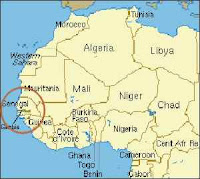
Gambian president opposes peacekeeping intervention in Burundi

Burundi is in danger of experiencing a genocide between Tutsis and Hutus, sparked by the president's election for a third term last summer (boycotted by the opposition). The constitution limits president's to two terms, but the president decided his first term didn't count because he was elected indirectly by the parliament instead of directly by the voters. The African Union charter allows a peacekeeping force to be sent by other AU nations if there is risk of serious violence, such as a genocide, even if it is against the will of the country's government. Burundi President Nkurunziza doesn't want some foreign troops interfering. Other presidents with extremely questionable legitimacy, such as Gambia's President Yahya Jammeh , would like presidents to have the prerogative of keeping meddling peacekeepers out when violence breaks out.

Benin's front runner runs further in front, with help from main opposition party

As I mentioned a few weeks ago, Lionel Zinsou , who has been prime minister for around 6 months, is President Yayi Boni's chosen successor and is considered the frontrunner, in a presidential field with almost 50 contestants. On Saturday, Adrien Houngbedji and his PRD party have thrown their support behind Zinsou. Houngbedji has run for president in all five presidential elections Benin has held since multiparty elections were re-introduced in 1991. In 1996 and 2001 he placed third, and in 2006 and 2011 he placed second behind Yayi Boni. So his endorsement is a big deal. The election is February 28.  

Elections and Security in Niger (UPDATED)

I'm on my way to my daughter's rock concert so I'll add to this later - Nice Monkey Cage post from Lisa Mueller on the security situation in Niger, where a presidential election is scheduled for February 21. UPDATE: Issoufou is favored to win, but there are two fairly strong candidates running against him. On the other hand, one of those two challengers was jailed for accusations of baby trafficking , prompting a lawyers' strike . Mueller notes that another presidential candidate, a physician, is being investigated as a suspect in Burkina Faso's recent bombing, after he tended to victims of the bomb blast, and in December Issoufou sacked nine military officers in December for a suspected coup plot. The recent military coup in neighboring Burkina Faso  just before that country's presidential election can't be far from his mind. So Issoufou obviously isn't feeling safe. Apart from the security of his office, Issoufou needs to worry about the relat...

New Islamic State in West Africa

Image
The Economist reports on Gambia's president announcing that the country is now an Islamic Republic. A little information about Gambia - it has fewer than 2 million people, it had what many considered free and fair elections from independence until 1984 under Dawda Jawara, until he was overthrown in a military coup by the current president, Lieutenant Yahya Jammeh. Jammeh proclaimed Gambia an Islamic Republic on December 15, but the secular constitution is so for unaltered. A group of Islamic scholars, the Supreme Islamic Council, was deployed to stir up support for the decision, but it doesn't sound like Jammeh (who I'm pretty certain is not an Islamic Scholar) is going to give them any power over the presidency. Speculation about the reason for the change seems to focus on non-spiritual motives. One of Gambia's main industries is tourism (it has some nice beaches ), but the Ebola scare in nearby countries hurt that sector of the economy, and Western donors h...

Challenges and opportunities for new president of Burkina Faso

The Monkey Cage has a nice post by Arsène Brice Bado summarizing the challenges facing Burkina Faso's first president in nearly 30 years. It's a short article/listicle, so you might want as well go ahead and take a look, but here it is in 30 seconds or less:

Terrorist attack in Burkina Faso (UPDATED)

Image
Soldiers stand guard in front of the Splendid Hotel after an attack on the hotel and a restaurant in Ouagadougou, Burkina Faso, January 18, 2016. REUTERS/JOE PENNEY President Kobara is off to a tough start. Twenty-nine civilians from seven countries were killed in a violent terrorist attack in the nation's capital. "Officials have not yet been able to determine whether al Qaeda in the Islamic Maghreb (AQIM) and al Mourabitoun, groups that claimed responsibility for both attacks, used a local jihadist cell or sent fighters from northern Mali." AQIM is part of Al Queda and was launched in Algeria, spread to Mali where it took over half the country until the French dropped some bombs, after which it expanded into Tunisia and Morocco. I believe this would be AQIM's first attack in Burkina Faso. UPDATE: The Monkey Cage has a nice extended post about what the attack means for Burkina Faso - consequences, challenges, etc. Check it out.