Posts

Guinea Bissau crisis update: national unity government talks break down

Image
After one prime minister was dismissed the president and another resigned in response to an outcry from parliament, elder statesman Carlos Correia (pictured above) became Prime Minister (all 3 PMs were from the ruling party, the PAIGC). To reduce the instability and potential of internal rebellion, Correia tried to bring the second largest party, the Party of Social Renewal (PRS), into the cabinet. Talks broke down over how many ministries the PRS would receive. The PAIGC has enough seats to approve the cabinet without the PRS (in the 2014 election , PAIGC won 57 of 102 seats with 48% of the vote), but Correia was hoping for a "national unity government" with the PRS, which holds 41 seats.

Buhari makes his own deadline to appoint cabinet ministers

Image
Nigeria's President Muhammadu Buhari addresses attendees during the 70th session of the United Nations General Assembly at the U.N. headquarters in New York, September 28, 2015. REUTERS/EDUARDO MUNOZ In July, President Buhari said he would wait until September to appoint cabinet ministers, so that new rules of conduct and good governance could be put into place. Today is the last day of September, and Buhari submitted the names of his nominees today to the senate for approval. From a quick Google search, I'm not sure what the new rules of conduct and good governance are, and whether they've been put into place, except for this: "a directive that all federal revenue-generating institutions, including the opaque state oil company, begin paying their revenues into a single Treasury account instead of a web of largely untracked private bank accounts." The oil industry is probably the main source of corruption in Nigeria, so his reforms in that sector a...

Cote d'Ivoire opposition wants new electoral commission; some still question president's nationality

Image
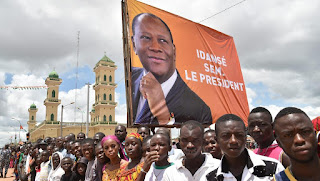
Supporters of President Alassane Ouattara when he arrived in Daloa, Ivory Coast, September 27, 2015. AFP PHOTO / ISSOUF SANOGO Reuters reports that some of Cote d'Ivoire's opposition is still complaining that the Elecotral Commission is biased in favor of the government (President Ouattara is running for his first re-election). Estimates of attendance at an opposition rally today range from 300-700, including 5 of the 10 presidential candidates . The same article mentions that protestors question Ouattara's nationality. Unlike America birthers , these protestors don't necessarily question whether Ouattara was born in Cote d'Ivoire - his Ivoirité is questioned based on the birthplace of his parents. In 1994, an Electoral Code was adopted that required not only the presidential candidate to be born in Cote d'Ivoire, but also BOTH of his or her PARENTS. I'm not sure if it's known where Ouattara was born - he himself was reportedly born in 1942 near ...

Burkina Faso Presidential Guard stepped down but refuses to disarm

Image
Presidential guard soldiers are seen on the grounds of the Laico Hotel in Ouagadougou, Burkina Faso, Sept. 20, 2015 VOA reports that the Presidential Guard (RSP) that launched a coup 12 days ago and then stepped down last week in response to pressure from the people, the regular army, and the international community is now refusing to disarm. This is not terribly surprising that the RSP does not want to disarm. It stepped down in exchange for the safety of its members and their families. Protestors are calling for leaders of the coup to be executed. One reason military governments are willing to negotiate their exit, as the RSP did, is because they can enforce conditions such as amnesty for the coup because the military holds weapons. Geddes notes that "Militaries can enforce compliance with amnesties and other deals, but only if they can make credible threats to respond with violence if the new government reneges." If the RSP disarms, it will be relying on the w...

Burkina Faso coup defeated; interim government back in charge

Between holidays and classes starting I haven't had a chance to blog since Tuesday, and a lot has happened in Burkina Faso since then. The coup against the interim government happened on Wednesday, September 16, as the country prepared for elections in October. The day after the coup, my prediction was that "It is unlikely that the military will remain in power for long. ... There will likely be a transition to civilian rule in the not-too-distant future, and elections. The CDP will not likely be excluded from those elections. In fact, parties who attempted to ban the CDP may be banned themselves .... Perhaps the best we can hope for is that the military will negotiate some prerogatives and protections for itself (such as military control over the military budget and amnesty for the events of 1987 and this latest coup) ..." So I was right about the coup not lasting long and the return of elections, but I didn't appreciate at the time the lack of support the presi...

Burkina Faso is a reminder that successful democracies need more than just multiparty elections

Image
Landry Signé provides his insightful analysis on the Burkina Faso coup in this morning's Monkey Cage  (I added a link to one of my posts that he must have forgot☺): Even if observers in the international community were surprised by what some have called a “ disaster for Africa ,” this unconstitutional seizure of power was predictable , and if it didn’t happen before the elections, it could have happened after the elections. My research suggests this “disaster” is a result of weak horizontal accountability during the transition. Simply put , horizontal accountability is the ability of government institutions to check abuses by other branches of government and a system in which government institutions are independent and no agency or branch becomes too powerful compared to the others. Some may refer to this system as one with “checks and balances.” ... Even before the coup attempt by the presidential guard, the legitimacy and impartiality of the transition was a concern fo...

Burkina Faso army orders coup leaders back to barracks; dueling focal points in battle of the sexes

Image
Source: AFP In my first post on last week's military coup in Burkina Faso, I predicted that "It is unlikely that the military will remain in power for long." However, I'll be the first to admit I had no idea the coup would end the way it seems to be ending. Quick background: President Compaore's 27-year rule ended on Halloween last year in response to street protests when he and his ruling party, the CDP, tried to remove the term-limits so Compaore could run for another term as president. An interim government planned for elections in October 2015, but a new electoral code banned the CDP and its allies from running. The CDP appealed to the ECOWAS Court, and that Court said the ban violated the former ruling party's human rights, but the Burkina Faso Constitutional Court ignored that ruling and enforced the electoral code, banning the CDP. Meanwhile, a commission of the interim government recommended disbanding Compaore's elite presidential gua...